Many dreams hovered over Eritrea, once. Its capital, Asmara, was the illusion of an African Rome that would have replicated a city’s glamour and flair. Mussolini dreamt of transforming Asmara into the capital of the African Empire of Italy. In addition to encouraging the emigration of Italians in the 1930’s, he sought to transform Asmara, which he called Little Rome, into a sort of avant-garde urban utopia for the time, full of cafes, cinemas, tree-lined boulevards. Upon this dream, several visionary architects were summoned in order to explore their most bizarre and audacious ideas.

Today, Eritrea has many stories to tell and it’s the most obsolete former Italian region there is.
The Splendor of Yesterday
Asmara was a promising land for Italians. A city that represented everything Rome was at the time and more. When I walked down the streets, I could feel the 50’s vibe just by glancing at the gentlemen passing by, dressed in their finest clothes, classy sunglasses and fancy walking sticks. It wasn’t far off from the black and white photos I had seen of Asmara.

Back in the day, Asmara looked like wonderland for any European seeking glamour away from their Old Continent. Italian architecture was what made this town so magical. Old style cinemas, petrol stations, residences. The nostalgicdolcevitawas found in every corner.

The Decay of Today
Eritrea, frozen in time by war and secrecy, is still pretty much cut off from the rest of the world and the vestiges are still very vivid today. After the occupations led by the Ottomans, the Egyptians, the Italians, the British and then the Ethiopians, Asmara’s glamorous buildings are revealed once again to the world – leaving everyone besotted.
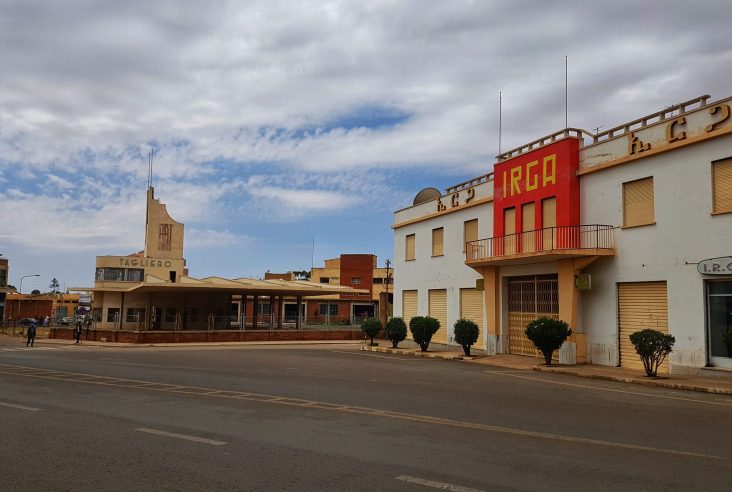
The country’s history has left Eritrea, especially Asmara’s buildings, in a time capsule: there are art deco cinemas, petrol stations, pizzerias, trattorie, and boulevards built for bicycles. Much of it in a state of decay.
The Fiat building, famous icon of Italian creative architecture, now stands rundown and alone at the heart of a complex city, in a complex country.

Like many others still standing in the capital, its history has been neglected over the years; the building was barely accessible to anyone outside the city until the early 1990s.

The same abandoned appearance goes for many other Italian iconic landmarks.

The older generations still speak Italians. I met a few bubbly older people that were very happy to exchange few words of our common language.

The Italian renascence is vivid. Residences, schools, and other buildings felt like an odd reminder of home to me.
Life at Night
I fell in love with Asmara. Harnet Avenue, the main street of Asmara, was my favourite road to walk. I had read in my guidebook (most available guidebooks on Eritrea are dated back to 2006) that Harnet Avenue is the perfect place to watch the world go by and catch the still enduring glamour of people.

At night, cafes and streets are full of people, especially Harnet Avenue. This main road was initially called Mussolini Avenue and then Haile Selassie Avenue. Today, Harnet Avenue was and still is the central boulevard, once barred to Eritreans from the racial segregation that existed in colonial times.

Now it is full of Eritrean people sitting at cafe tables drinking espresso or eating ice cream, both habits inherited from the occupation. Asmara was in fact Mussolini’s dream reserved for Italians, while the local population was relegated to humble and well-defined places and roles, under penalty of punishment and arrest; Asmara, then occupied by the British and then by the Ethiopians, is now a quiet beautiful city where Eritreans walk with a certain hardship on their faces.

Feel like visiting?
As I mentioned inmy previous post, entering Eritrea is no piece of cake. Few airlines fly into Asmara (Egypt Air, Turkish Airlines, Qatar Airways), a visa lasting a maximum of one month is required,cash money is an ordealif you’re not warned in advance and there are restrictions if you are a journalist. Despite this, the Eritrean government has pushed hard to obtain UNESCO recognition, regardless the international criticism that accuse the country of not investing enough in cultural heritage and especially President Isaias Afwerki of repeated violations of rights human. Afwerki has been in power since 1993, when his party (the EPLF, The Eritrean People’s Liberation Front) gained independence from Ethiopia, effectively imposing an oppressive regime where freedom of press and speech are still not a possibility.
However, it is a jewel in the desert. It is the Eritrean people that will enchant you with their kindness and peaceful demeanor. A country that still lingers in secrecy for the benefit of those travelers like myself who seek truly rewarding experiences.

Below is a photo of the enigmatic Massawa. Massawa, its endless beauty and crushing history, will take the lead on my next post.
